Event analysis
Can the team inspect meaningful product actions and their context?
Product analytics tools
The right product analytics software is not the platform with the longest feature list. It is the tool that answers your recurring product questions, matches your implementation capacity, and gives your team an operating model it can sustain.
01
Before comparing product analytics tools, write down the decisions you expect the data to support. Early SaaS teams usually need to understand activation, feature use, signup or checkout drop-off, and the path before a user converts.
If acquisition reporting is the main requirement, choose web analytics. If behavior after entry matters, start with the product analytics category and define the actions that represent progress.
02
Vectr4 provides browser event collection, page activity, identify calls, useful properties, and a self-hosted ingestion service. See the technical event tracking page for the collection layer.
03
Vectr4 keeps those workflows together in a focused dashboard. Continue with event analytics or user behavior analytics for the analysis intent.
Can the team inspect meaningful product actions and their context?
Can ordered steps expose conversion and drop-off?
Can activity be reviewed as a sequence without claiming replay?
Can the team follow paths across the product over time?
04
Hosted product analytics reduces infrastructure work. Self-hosting gives the operator more control over deployment and data location, but transfers responsibility for security, backups, updates, capacity, and availability.
Vectr4 is built for the second model: a Docker Compose deployment operated by the customer. Self-hosting does not by itself make an implementation private or compliant; what you collect and how you operate it still matter.
05
PostHog, Amplitude, and Mixpanel are broader platforms suited to teams that need deeper segmentation, mature integrations, and larger data workflows. Vectr4 is intentionally smaller: events, funnels, sessions, journeys, and customer-operated deployment for technical small teams.
Vectr4 does not claim feature parity with those platforms. It is a fit when focused scope and infrastructure ownership matter more than a broad module catalog.
06
07
Vectr4 provides a hosted demo so the product workflow can be inspected before purchase. A technical team can then review the Docker documentation and decide whether customer-operated analytics is appropriate.
Vectr4 example
Define 5–10 meaningful events → connect one activation funnel → inspect real sessions and journeys → verify deployment and backup responsibility → decide.
Product proof
The hosted demo shows the same focused workflow described on these pages: captured events, funnel steps, session activity, and user paths. The values shown in marketing previews are illustrative, not customer benchmarks.
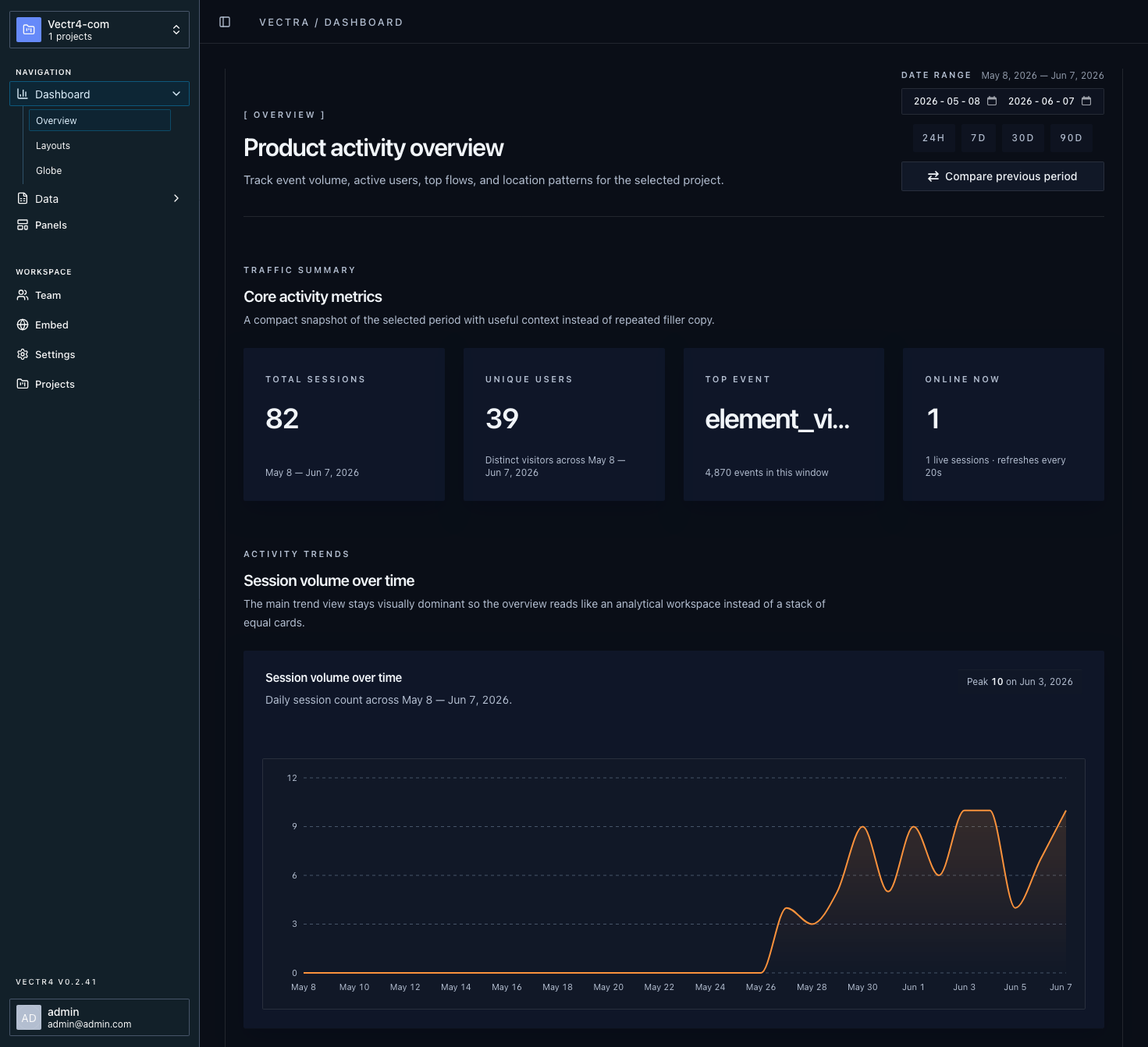
Review named product actions and the context sent with them.
Connect ordered events to see progress and drop-off between steps.
Group activity into visits so isolated actions have sequence and timing.
Follow the paths users take through your product over time.
FAQ